
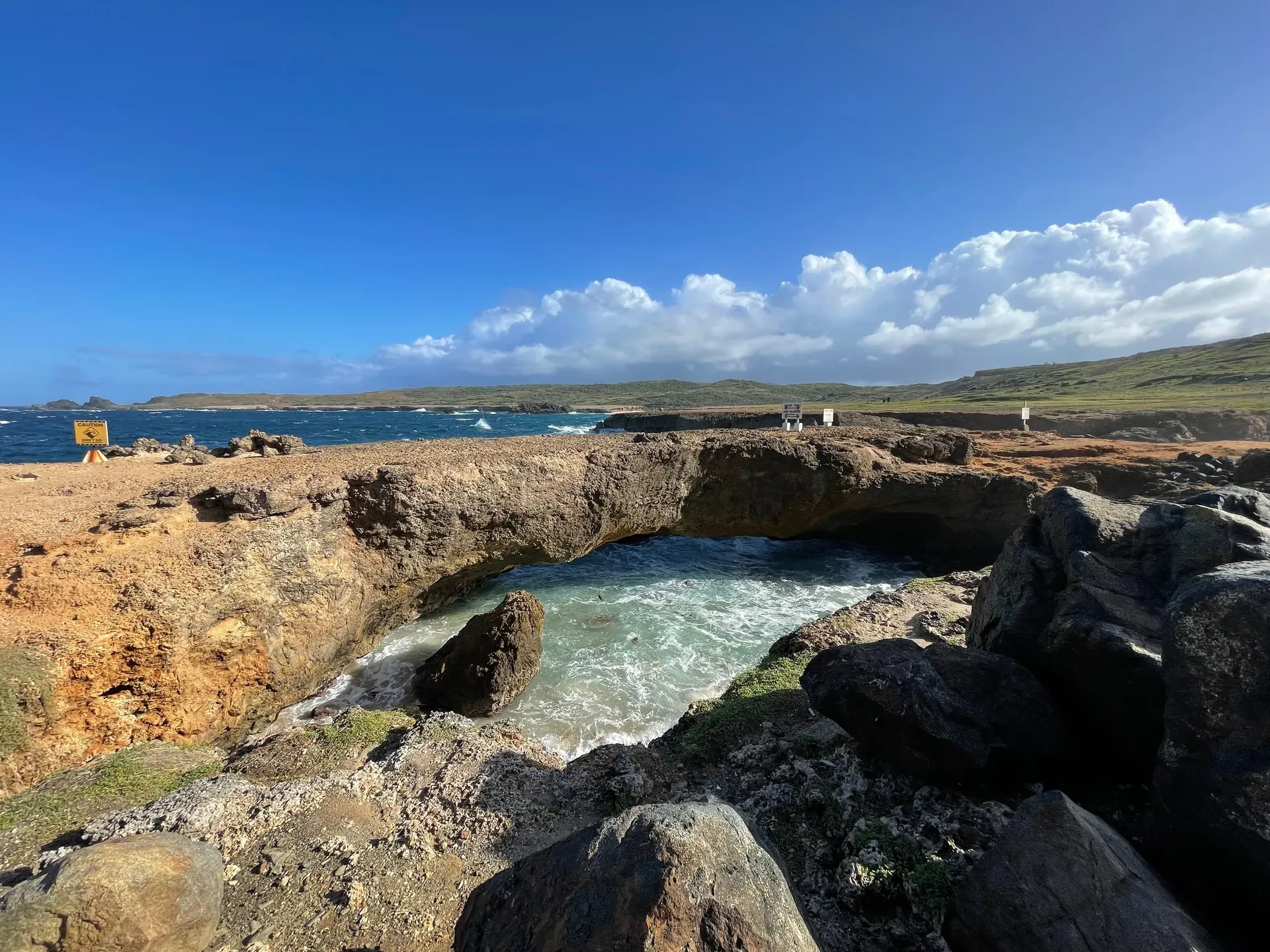
Entry to Arikok National Park costs USD 22 per adult for a conservation day-pass, sold at the San Fuego and Vader Piet entrances, with children under 17 free. The park opens daily — 8:00 am to 3:30 pm at San Fuego, 8:30 am to 3:00 pm at Vader Piet — and you'll want to arrive early, since cave visits and ranger tours wind down well before closing.
Arikok National Park is open daily, year-round. The main San Fuego entrance and Visitor Center run 8:00 am–3:30 pm; the Vader Piet entrance keeps shorter hours, 8:30 am–3:00 pm. There's no day off and no seasonal closure, though the October–January rainy season can muddy the interior dirt tracks.
Swipe to see more
| Day | Hours | Note |
|---|---|---|
| Monday–Sunday | 08:00–15:30 | San Fuego entrance and Visitor Center. Vader Piet entrance opens 8:30 am and closes at 3:00 pm. |
The park doesn't close for public or religious holidays — it operates the same daily schedule all year, and Aruba's position outside the hurricane belt means no storm-season shutdown. The only seasonal wrinkle is weather: November, the wettest month at about 3.8 in (98 mm) of rain, can leave the unpaved roads to the Natural Pool muddy and rough. Ignore older listings showing 8 am–4 pm; the park authority (ACF) posts the 3:30/3:00 pm closings, and cave visits and ranger tours wind down before then, so arrive early.
Entry to Arikok National Park costs USD 22 per adult for a conservation day-pass, sold at the San Fuego and Vader Piet entrances. Children under 17 get in free, and residents of Aruba, Bonaire and Curaçao pay a discounted rate with a local government-issued photo ID. Ignore older articles quoting USD 11–20 — those prices are years out of date.
Swipe to see more
| Category | Price | Note |
|---|---|---|
| Adult (17+) | USD 22 | Conservation day-pass, required by law; sold at both the San Fuego and Vader Piet entrances, no advance booking needed |
| Child (under 17) | Free | |
| Local resident (Aruba, Bonaire, Curaçao) | Discounted | Valid local government-issued photo ID required at the entrance |
| Guided ranger hike (add-on) | USD 25 per person | On top of the day-pass; groups capped at 10 people; reserve ahead at [email protected]. Four options, from the easy 1.5-hr Cunucu Arikok and Miralamar walks to the hard Jamanota Hill (4.8 km, 2 hr) and Rooi Tambu–Dos Playa (7.5 km, 3.5 hr) |
| Guided 4WD/jeep tour (with hotel pickup) | From about USD 183 per adult | Half-day (4–5 hrs) with pickup from most island hotels; the practical route to the Natural Pool if you don't have a 4x4 |
| Cruise shore excursion | Bundled with the cruise line | Cruise passengers must book park tours through the cruise line rather than independently |
No regular free entry days — every visitor over 17 needs the USD 22 day-pass, which the Aruba Conservation Foundation puts toward managing the park.
Planning your visit to Arikok National Park? Find tours with free cancellation and skip-the-line options.
View All ToursThe best time to be inside Arikok is right at opening — 8:00 am at San Fuego, 8:30 am at Vader Piet — before the mid-morning jeep and UTV tour convoys clog the cave parking lots. Before 10 am the trails are at their coolest, and the low light makes the sun shafts in Quadirikiri Cave and the Boca Prins dunes far more photogenic. Come after 2 pm and you're racing the clock: cave visits and ranger tours wind down ahead of the 3:00–3:30 pm closings.
Swipe to see more
| Period | Crowd Level | Recommendation |
|---|---|---|
| Opening to 10:00 (08:00–10:00) | Low | Best window of the day — coolest trails, empty cave parking, and rangers on hand to advise on sea conditions at Conchi; this is the time for hikers and photographers. |
| Mid-morning (10:00–12:00) | High | Jeep and UTV tour groups arrive and the Quadirikiri and Fontein parking areas fill up; fine if you're on one of those tours, a patience test if you're not. |
| Midday (12:00–14:00) | Moderate | The shadeless park heats up fast and the rocks radiate it back; plan this stretch for the air-conditioned drive between stops or lunch at the park restaurant near Boca Prins. |
| Early afternoon (14:00–15:00) | Low | Crowds thin out, but so does everything else — cave visits and ranger tours wind down before closing, so this late slot only works for viewpoints, dunes, and a last 4x4 run to Conchi. |
| After 15:00 (15:00–15:30) | Low | Vader Piet gates shut at 3:00 pm and San Fuego at 3:30 pm; by now you should be out of the park or rolling toward the exit. |
Plan on half a day to a full day. A typical 4–5 hour circuit by 4x4 takes in the Visitor Center, the Quadirikiri and Fontein caves, the Boca Prins dunes and the Natural Pool, and covers the park's highlights in one loop. Add a ranger-led hike — anywhere from 1.5 hours on the easy Cunucu Arikok or Miralamar trails to 3.5 hours on the hard Rooi Tambu–Dos Playa route — and you've made it a full day.
The San Fuego entrance opens at 8:00 am (Vader Piet at 8:30), but don't cut it close — cave visits and ranger tours wind down well before the 3:30 pm closing. Arriving before 10 am gets you the coolest trails, empty cave parking lots, and the best light on Quadirikiri's famous sun shafts. Mid-morning, jeep and UTV tour groups roll in and clog everything.
Day-passes cost USD 22 per adult and are sold at both entrances — no advance booking needed for a standard visit. Kids under 17 get in free, and residents of Aruba, Bonaire and Curaçao get a discount with a local government-issued photo ID. Ignore older articles quoting USD 11–20; the Aruba Conservation Foundation price is the current one.
Guided ranger hikes (USD 25 per person, capped at 10 guests) must be reserved in advance by emailing [email protected]. Cunucu Arikok (5 km, easy) and Miralamar (2 km, easy) suit most visitors; Jamanota Hill and Rooi Tambu–Dos Playa are rated hard and earn it. Adding a hike turns a half-day circuit into a full, satisfying day.
February through April is the sweet spot — March is Aruba's driest month at about 15 mm of rain, with daytime temperatures around 87°F. October through January brings the rainy season, and November's roughly 98 mm can leave park dirt tracks muddy and rough on the 4x4 run to the Natural Pool. April–August splits the difference: warm weather, fewer crowds, lower hotel rates.
Sturdy closed shoes are non-negotiable — flip-flops will fail you on rocky trails and uneven cave floors. For hiking, wear long trousers and long sleeves against cacti, thorny scrub, and a sun that has almost nowhere to hide; pack water shoes and swimwear if Conchi is on your itinerary. Bring 2–3 liters of water per person, since restrooms and supplies exist only at the Visitor Center and the park restaurant.
Adults pay USD 22 for a conservation day-pass, which is the current official price from the Aruba Conservation Foundation — older articles quoting USD 11–20 are outdated. Children under 17 get in free, and residents of Aruba, Bonaire and Curaçao receive a discount with a valid government-issued photo ID. Guided ranger hikes cost an additional USD 25 per person.
Day-passes are sold on arrival at both park entrances, San Fuego and Vader Piet, so no advance booking is needed for a standard visit. If you want a guided ranger hike (USD 25 per person, capped at 10 people), reserve ahead by emailing [email protected].
The park is open daily, with the San Fuego entrance and Visitor Center running 8:00 am–3:30 pm and the Vader Piet entrance 8:30 am–3:00 pm. Ignore listings showing 8 am–4 pm — those are stale; the park authority's posted closings are 3:30 and 3:00. Arrive early, since cave visits and ranger tours wind down before closing time.
Budget half a day to a full day. A typical 4–5 hour circuit by 4x4 covers the Visitor Center, the Quadirikiri and Fontein caves, the Boca Prins dunes and the Natural Pool. Adding a guided hike — Jamanota Hill (2 hr), Cunucu Arikok (1.5 hr), Miralamar (1.5 hr) or Rooi Tambu–Dos Playa (3.5 hr) — turns it into a full day.
February through April are the driest, most comfortable months — March averages just 0.6 in (15 mm) of rain with daytime temps around 87°F (31°C). Aruba sits outside the hurricane belt, so the park stays open year-round, but October–January is the rainy season and November's 3.8 in (98 mm) of rain can leave the dirt tracks muddy and rough. Whenever you go, aim for before 10 am, when the trails are coolest and the jeep-tour crowds haven't arrived.
Not for the main sights — a standard 2WD handles the paved and well-maintained gravel roads to the caves and viewpoints. But the track to the Natural Pool (Conchi) requires a 4x4, a jeep tour, a horseback ride or a multi-hour hike. One catch: standard rental insurance usually excludes damage on unpaved trails inside the park, so buy off-road coverage before you go.
No to both. Dogs, cats and other domestic or exotic animals are prohibited, and ATVs, UTVs and motorbikes are banned from the park's protected nature areas — you get around by licensed 4x4, on foot or on horseback. Breaking park rules can draw fines up to USD 100,000 under Ministerial Order AB 2000 no. 59, which also covers littering, rock stacking, drones and collecting plants or animals.
Browse verified tours with free cancellation and instant confirmation.
Find Tours